
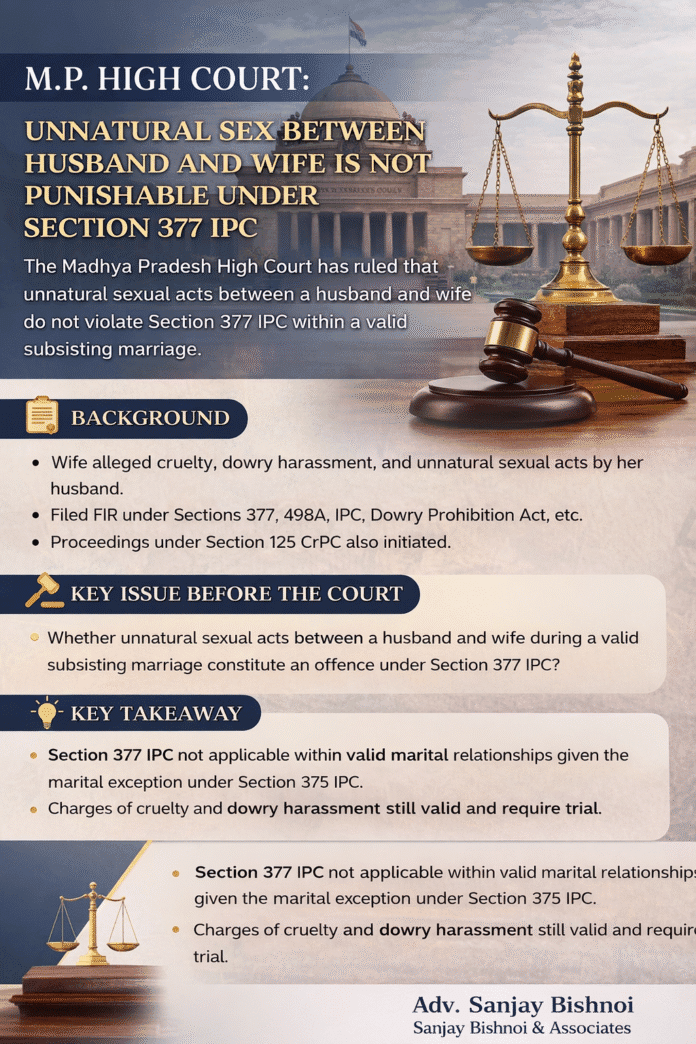
The jurisprudence surrounding Section 377 of the Indian Penal Code continues to evolve, particularly when examined in the context of marital relationships. In a recent and significant ruling, the Madhya Pradesh High Court addressed whether allegations of “unnatural sexual acts” between a husband and wife can attract criminal liability under Section 377 IPC.
Home Blog
Fast Bail in Cyber Fraud Case in India | Best Cyber Crime Bail Lawyer in Haryana

Fast Bail in Cyber Fraud Case in India – Best Lawyer in Haryana for Cyber Crime Bail | Anticipatory Bail | IT Act Bail
Cyber fraud cases are increasing day by day in India, and many people are being arrested for online fraud, UPI fraud, banking fraud, OLX fraud, loan app fraud, and social media cheating. In such cases, the police usually register an FIR under the provisions of the Bharatiya Nyaya Sanhita, the IT Act, Sections 66C and 66D, cheating, forgery, and criminal conspiracy. These offences are treated as serious economic offences; therefore, getting bail requires a proper legal strategy. With the help of the best criminal lawyer in Haryana for cyber fraud bail, it is possible to secure bail quickly, even in serious cybercrime cases.
Arrest Under Section 35(6) BNSS Must Be Based on Fresh Material: Supreme Court
JiA Crucial Safeguard Against Arbitrary Arrests
The Supreme Court of India has delivered an important interpretation of Section 35 of the Bharatiya Nagarik Suraksha Sanhita, 2023 (BNSS), reinforcing constitutional safeguards surrounding arrest and personal liberty.

The Court has categorically held that an arrest under Section 35(6) BNSS cannot be made mechanically or routinely. Such arrest must be founded on fresh material or new circumstances that arise after the issuance of a notice under Section 35(3), and not merely on the grounds already mentioned in the notice.
Understanding Section 35 BNSS: Notice Before Arrest
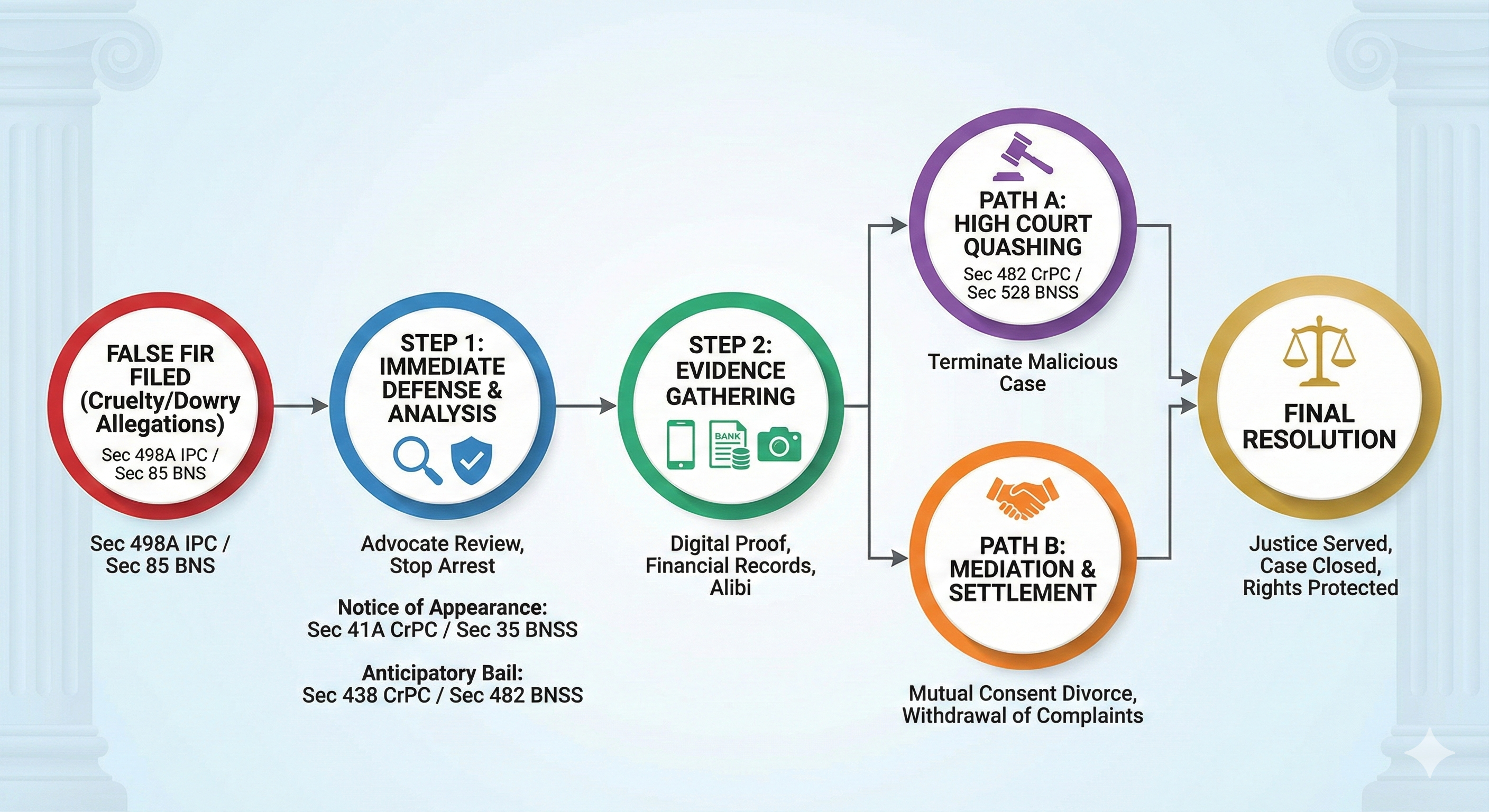
HOW TO DEFEND YOURSELF AGAINST FALSE CASES UNDER SECTION 498A IPC / SECTION 85 BNS
Strategic Defence Against False 498A IPC and 85 BNS Cases: By Advocate Sanjay Bishnoi
Facing a false allegation of cruelty or dowry harassment is a life-altering event. Under the new legal framework—the Bharatiya Nyaya Sanhita (BNS) and the Bharatiya Nagarik Suraksha Sanhita (BNSS)—the landscape has changed. You must act strategically from Day 1 to protect your reputation and your family.
Quick Summary of Defense
How to Unfreeze a Bank Account After a Cyber Complaint in India
By Adv. Sanjay Bishnoi | Sanjay Bishnoi & Associates
Read More
With the rapid growth of online transactions, digital payments, crypto trading, and internet-based services, cyber fraud incidents have increased significantly across India. As a preventive measure during investigation, Cyber Crime Police often direct banks to freeze accounts suspected of being linked to fraudulent transactions.
In many cases, innocent individuals and businesses face sudden financial restrictions merely because a disputed transaction passed through their account, even without their knowledge or involvement in any cybercrime.
This article by Adv. Sanjay Bishnoi, Criminal & Cyber Crime Advocate, explains the legal basis for Cyber Cell bank account freezes, the rights of account holders, and the lawful remedies available under Indian law to restore access to such accounts.
Cyber Fraud Cases in India: Legal Remedies, Bail & Compromise under IPC and BNS
Understanding Cyber Fraud Cases in India
With the rapid growth of digital transactions and online platforms, cyber fraud cases have increased significantly across India. The convenience of digital payments has also opened doors to misuse, resulting in serious financial and legal consequences for individuals and businesses alike.
Some of the most common forms of cyber fraud include:
- Online cheating and fraud
- Fake investment and trading schemes
- UPI and banking frauds
- Identity theft and impersonation
- Misuse of digital platforms for unlawful financial gain
Madras High Court: Police Can Freeze Only Suspected Fraud Amount, Not Entire Bank Account
Madras High Court Rules Police Can Freeze Only the Suspected Fraud Amount
In a landmark judgment protecting individual rights, the Madras High Court ruled that police or investigating agencies cannot freeze an entire bank account unless the whole balance is proven to be connected with the alleged crime.
Only the specific, quantified, suspect amount may be frozen.
This is significant because, across India, citizens regularly face blanket bank freezes triggered by cybercrime complaints—often without proper basis or verification.
Read more: Madras High Court: Police Can Freeze Only Suspected Fraud Amount, Not Entire Bank AccountBackground of the Case –
In Mohammed Saifullah v. Reserve Bank of India & Others, the suspicious amount was only ₹2,48,835, but the bank froze the petitioner’s entire account balance of nearly ₹9.7 lakh.
This was held to be excessive, arbitrary, and violative of constitutional protections.
Key Highlights of the Judgment –
1. Police must identify the exact tainted amount –
Freeze orders cannot be vague. They must clearly mention the amount under suspicion.
2. Freezing the entire account violates fundamental rights –
It impacts livelihood, dignity, business, and day-to-day survival — violating Articles 14, 19, and 21.
3. Only the disputed amount may remain frozen –
The Court ordered the bank to de-freeze the account except for a lien on the suspected amount.
4. Banks must ensure proper legal compliance –
Banks cannot mechanically block entire accounts without proper authorisation and quantification.
5. Freeze orders must be transparent –
Freeze orders must be transparent and clearly communicated. The affected person must be informed of the following details:
- Reason for freezing the account
- Exact amount frozen
- Applicable case or FIR details
- Expected duration of the freeze
Implications of This Judgment :For Police & Cyber Cells
- Must specifically quantify the suspicious amount
- Must avoid blanket freeze orders
- Must provide proper written justification for the freeze
For Banks
- Must freeze only the legally identified amount
- Must avoid unconstitutional blanket freezes
- Must clearly communicate the freeze details to customers
For Citizens
- Can demand partial de-freezing of accounts
- Can challenge illegal freeze orders
- Can rely on this judgment while filing writ petitions
If Your Bank Account Is Frozen — Know Your Legal Options
- A bank account freeze can cause significant financial hardship, especially when the entire balance is blocked without justification.
- You can submit a formal representation to the concerned bank and the investigating agency seeking clarification and relief.
- You may request that only the “tainted” or disputed amount be kept under freeze, instead of the full account balance.
- Supporting documents such as bank statements and proof of legitimate income can be submitted to strengthen your case.
- You can rely on the Madras High Court judgment, which emphasizes transparency, proportionality, and discourages blanket freeze orders.
- If administrative remedies fail, you have the right to file a Writ Petition under Article 226 of the Constitution of India before the High Court for de-freezing of the account.
- The author has successfully handled multiple such cases, securing partial or complete relief for affected clients through legal intervention.
Author’s Observations — Adv. Sanjay Bishnoi
- This judgment restores the balance between investigation and individual rights
Freeze powers were increasingly being misused. This ruling reinforces the requirement of proportionate and lawful action by investigating agencies. - Indiscriminate freeze orders are a serious systemic issue
Even a minor suspicious credit of ₹1,000–₹5,000 often results in the freezing of an entire bank account, causing unnecessary hardship to innocent individuals. - Quantification of the tainted amount is constitutionally mandatory
A freeze order issued without identifying the specific suspicious amount becomes arbitrary and violates fundamental rights guaranteed under the Constitution. - Police procedures require urgent improvement
Many freeze orders are issued without proper authorisation, recorded reasons, or case details. This judgment will compel agencies to adhere to due process. - Innocent recipients of fraud-linked funds also deserve protection
Individuals who unknowingly receive fraud-related credits should not be penalised through complete account freezes. - The judgment significantly strengthens arguments before the courts
It supports key submissions commonly raised in writ petitions, including:- Proportionality
- Financial hardship
- Arbitrary exercise of power
- Procedural lapses
- Proportionality
- The ruling promotes uniformity across states
Preview –
Many states follow inconsistent practices. This ruling sets a strong precedent for future cases.
Conclusion –
The Madras High Court judgment brings much-needed discipline, fairness, and proportionality to financial freeze actions. Investigations must continue, but not at the cost of citizens’ constitutional rights.
Freezing only the tainted amount—not the entire account—is the correct legal and ethical standard.
Author Details
Adv. Sanjay Bishnoi
Cyber Law | Criminal Law | Financial Fraud & Account-Freezing Matters📍 Chamber No. 406 & 460
New Lawyers Chambers Complex,
District & Sessions Court, SirsaLocation 📍 Chamber No. 92
District & Sessions Court, Fatehabad📞 Mobile: 9728029009
📧 Email: advsnjy@gmail.com Linkedin Profile
Punjab & Haryana High Court Declares Detention Illegal; Issues Contempt Notice to Haryana Police for Violating Supreme C
The Punjab & Haryana High Court has once again reinforced the importance of safeguarding personal liberty and ensuring strict compliance with statutory arrest procedures. In a recent order, the Court declared the detention of two individuals—Mrigank Malhotra and his mother, Gunjan Malhotra—illegal and unjustified, issuing a contempt notice to the Haryana Police for failing to comply with the mandatory guidelines laid down by the Hon’ble Supreme Court in Satender Kumar Antil vs. CBI & Anr, 2022 LiveLaw (SC) 577.
This case serves as a significant reminder that arrests cannot be made mechanically, especially in business-related disputes and offences carrying a punishment below seven year
Background: Habeas Corpus Petition Filed at Night
Can WhatsApp Chats Be Used as Evidence in Indian Courts? (2025 Update)
In today’s digital age, WhatsApp has become one of the primary modes of communication. Disputes—whether civil, criminal, matrimonial, commercial, or employment-related—often involve crucial conversations exchanged on WhatsApp. This naturally raises an important question: Are WhatsApp messages legally admissible as evidence in Indian courts?The answer is: Yes, but only when produced correctly and properly certified.
This blog explains the legal position under the Indian Evidence Act, and the updated framework under the Bharatiya Sakshya Adhiniyam (BSA), 2023.1. Legal Basis: WhatsApp Chats as Electronic EvidenceWhatsApp messages fall under the category of electronic records. In India, electronic records are admissible provided they comply with the requirements of Section 65B of the Indian Evidence Act, 1872 (now BSA Section 63 under the new law).
This blog explains the legal position under the Indian Evidence Act, and the updated framework under the Bharatiya Sakshya Adhiniyam (BSA), 2023.1. Legal Basis: WhatsApp Chats as Electronic EvidenceWhatsApp messages fall under the category of electronic records. In India, electronic records are admissible provided they comply with the requirements of Section 65B of the Indian Evidence Act, 1872 (now BSA Section 63 under the new law).
✔ WhatsApp messages are admissible
⚖️ Landmark Supreme Court Judgment Protecting Advocates from Unlawful Summons under Section 132 BSA
2025 INSC 1275 – Suo Motu Writ Petition (Crl.) No. 2 of 2025 & Ors.