
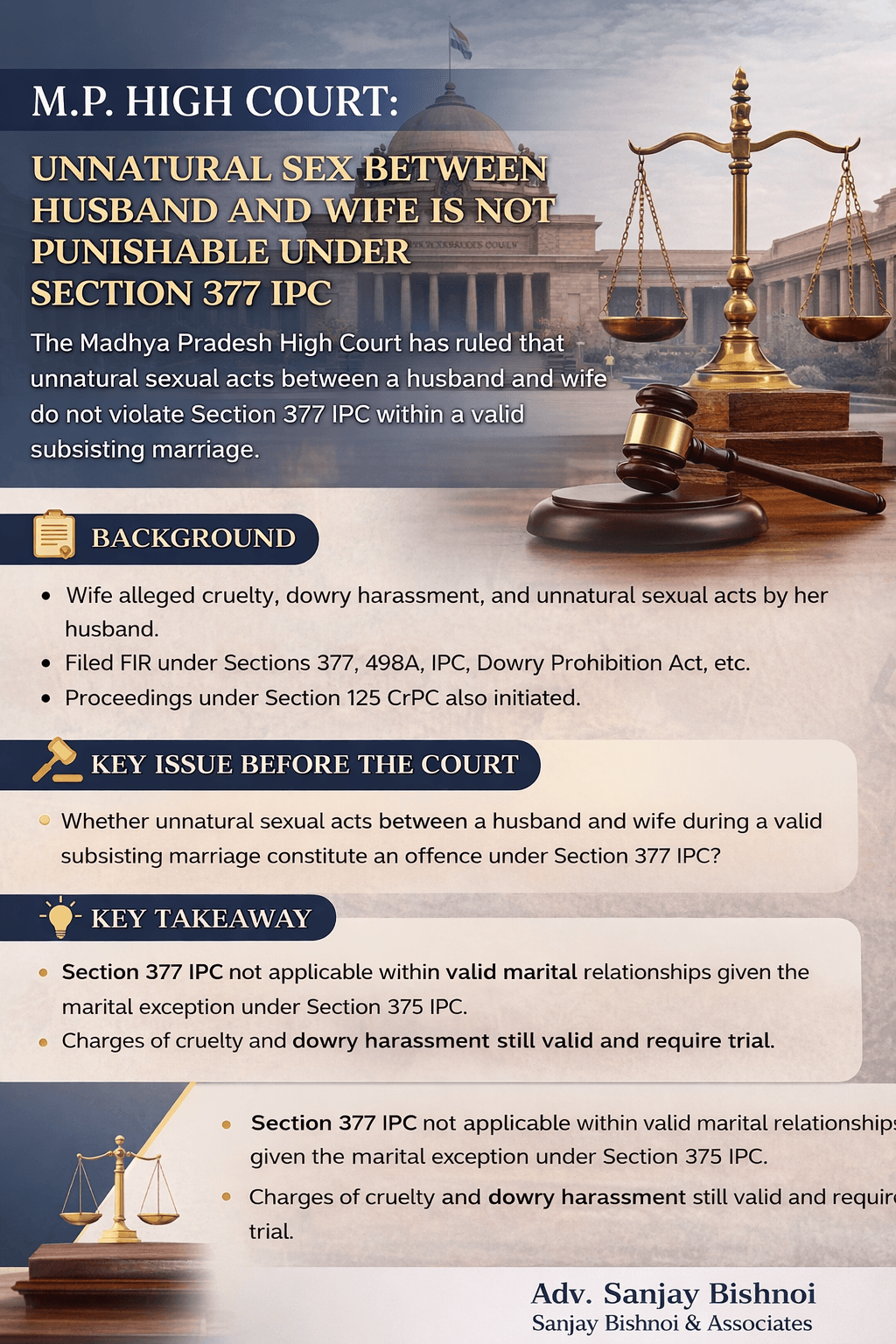
The jurisprudence surrounding Section 377 of the Indian Penal Code continues to evolve, particularly when examined in the context of marital relationships. In a recent and significant ruling, the Madhya Pradesh High Court addressed whether allegations of “unnatural sexual acts” between a husband and wife can attract criminal liability under Section 377 IPC.
🔹 Background of the Case
The complainant (wife) alleged that after her marriage, she was subjected to continuous cruelty and harassment by her husband and his family in connection with dowry demands. It was further alleged that the husband subjected her to physical and sexual abuse, including unnatural acts, accompanied by threats and assault.
Subsequently, an FIR was registered against the husband and his family members under multiple provisions, including:
• Section 377 IPC
• Section 498A IPC
• Sections 323, 294, 506, 354 IPC
• Section 34 IPC
• Section 30 Arms Act
• Sections 3/4 of the Dowry Prohibition Act
Additionally, proceedings under Section 125 CrPC were also initiated.
🔹 Key Issue Before the Court
The primary legal question before the court was:
Whether unnatural sexual acts between a husband and wife, during the subsistence of a valid marriage, constitute an offence under Section 377 IPC?
🔹 Relevant Legal Framework
The court examined the interplay between:
• Section 375 IPC (Rape)
• Exception 2: Sexual intercourse by a man with his own wife (if she is above 18 years of age) does not constitute rape.
• Section 377 IPC (Unnatural Offences)
• Traditionally criminalises carnal intercourse “against the order of nature”.
🔹 Precedents Considered
The Court relied on earlier judicial pronouncements, including:
• Manish Sahu v. State of M.P.
Held that consent is a determining factor for invoking Section 377 IPC.
• Umang Singhar v. State of M.P. (2023 SCC OnLine MP 3221)
Observed that in light of the expanded definition of rape and the marital exception under Section 375 IPC, Section 377 IPC cannot be invoked for sexual acts between husband and wife during a valid marriage.
🔹 Findings and Reasoning
After examining the facts and legal position, the Court held:
• ✅ The allegations in the FIR did not prima facie disclose an offence under Section 377 IPC. Accordingly, proceedings under Section 377 IPC were quashed.
• ✅ The allegations against the sister-in-law were found to be general and omnibus, with no specific role attributed. Even in prior proceedings under Section 125 CrPC, no allegations were made against her.
➤ Therefore, FIR and proceedings against her were quashed.
• ✅ However, allegations relating to cruelty, dowry harassment, and other offences (against husband and in-laws) disclosed a prima facie case.
➤ These issues were held to require a full trial and evidence and could not be decided under Section 482 CrPC.
🔹 Conclusion
The Madhya Pradesh High Court partly allowed the petition and held:
• 📌 Section 377 IPC is not attracted in the present case within a valid marital relationship
• 📌 Proceedings against one accused (sister-in-law) were quashed
• 📌 Remaining charges to be adjudicated during trial
🔹 Key Takeaway
This ruling reinforces an important legal position:
In the context of a subsisting marriage, allegations of unnatural sexual acts may not automatically attract Section 377 IPC, particularly when read alongside the marital exception under Section 375 IPC.
At the same time, the Court has clearly maintained that offences relating to cruelty, dowry harassment, and assault remain fully prosecutable and must be examined during trial.
🔹 Final Note
This judgement highlights the nuanced interpretation of criminal law in matrimonial disputes and underscores the importance of specific allegations, supporting evidence, and the correct application of legal provisions.
For legal assistance or consultation in criminal and matrimonial matters, feel free to connect with:
Adv. Sanjay Bishnoi
Sanjay Bishnoi & Associates